
Effective communication between pilots and air traffic controllers (ATC) is central to aviation safety. Pilots are responsible for more than just flying an aircraft; they must also work closely with ATC to coordinate safe and efficient operations. Through this teamwork, mid-air collisions are avoided, flight paths are maintained, and navigation through airspace remains organized. Clear and timely communication ensures both pilots and controllers can respond effectively to changing weather, air traffic, and operational conditions.
Roles and Responsibilities of Air Traffic Controllers
Air traffic controllers manage aircraft movements in the air and on the ground to ensure a safe, orderly, and efficient flow of traffic. They rely on surveillance systems such as radar and ADS-B, along with automation displays in terminal and en-route environments, not GPS, which is used by pilots in the flight deck. Controllers also depend on communication networks and weather monitoring tools to keep traffic flowing smoothly.
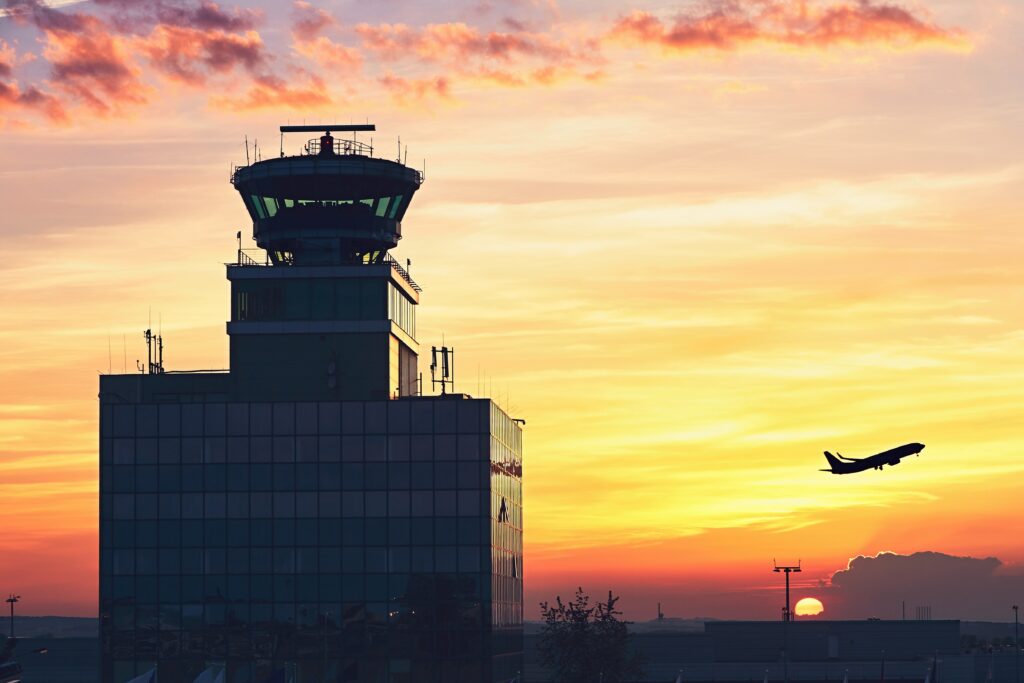
Controllers typically work in specialized sectors, including:
- Tower – Directs aircraft during takeoff, landing, and taxiing.
- Approach/Departure – Guides aircraft as they arrive and prepare to land.
- En Route Centers – Manages aircraft traveling between airports at cruising altitudes.
Each sector plays a crucial role in maintaining required separation between aircraft and ensuring compliance with designated flight routes from gate to gate.
ATC Procedures and Communication Tools
Air Traffic Clearance
Before operating in controlled airspace, pilots must receive clearance, which authorizes specific conditions under which they may proceed. Controllers consider air traffic, weather, and obstacles before issuing clearance, ensuring safety and efficiency.
Instrument Approaches and Departures
To provide safe transitions between runways and airways, controllers assign standardized instrument approach and departure procedures. These are published on aviation charts and supported by navigational aids such as VOR, ILS, and GPS. Selection depends on traffic volume, runway availability, and weather conditions.
Missed Approach
When a landing cannot be completed due to weather or other factors, a missed approach or go-around may be executed.
- IFR Missed Approach: Pilots must fly the published missed approach unless ATC issues alternate instructions. Expect vectors, holding, or resequencing. Standard call: “going missed”.
- VFR go-around: May be pilot-initiated or instructed by the tower. Expect pattern instructions such as “make right closed traffic” or “fly runway heading.”
ATC then issues new landing clearance, vectors for resequencing, or alternate routing, always prioritizing safety.
Vectors
Vectors are ATC-assigned headings that guide aircraft safely through various phases of flight. They help maintain separation, ensure orderly sequencing, and direct traffic flow, particularly in busy airspace. Pilots are expected to follow vectors precisely for safety and efficiency.
Traffic Advisories and Other Communications
Controllers provide traffic advisories to alert pilots of nearby aircraft. Pilots respond by reporting “traffic in sight” or “negative contact”.
Additional communication tools include:
- Read back – Pilots repeat ATC instructions to confirm understanding.
- The 4 W’s – State who you are calling, who you are, where you are, and what you want.
- ICAO/FAA Standard phraseology – Use precise, standardized terms to avoid miscommunication.
- Local airport advisories – Updates for aircraft operating within about a 10-mile radius.
- Resolution advisories (RAs) – Issued by onboard TCAS, not ATC. Pilots must follow RAs immediately to avoid conflict, then notify ATC.
Start Your 2-Week Free Trial with MzeroA Online Ground School
MzeroA Online Ground School provides the tools, resources, and training videos you need to master ATC communications with confidence. Visit www.mzeroa.com/trial to start your two-week trial, think of it as a discovery flight for our online ground school. And remember… a good pilot is always learning.