
Fly beyond blue skies with reliable instrument skills.
I spent five years working the dispatch desk at my home airport’s FBO. On gray mornings, the scene was predictable: a pilot, coffee in hand, pacing between the lounge and the window, checking ForeFlight one last time—then canceling.
The instrument-rated pilots? Already on the ramp preflighting.
I used to be that first pilot—canceling more flights than I flew, at the mercy of a cloud layer or morning fog. Earning my instrument rating changed everything. I learned to manage the weather instead of waiting on it.
What Is an Instrument Rating, Really?
The instrument rating (IR) is an FAA qualification that allows you to fly under Instrument Flight Rules (IFR). That means you can safely operate in low-visibility conditions—within clouds, through haze, or in weather where visual references aren’t available.
Instead of relying on the horizon outside your window, you’re trained to trust what your instruments are telling you. It’s a complete skill shift: reading a symphony of gauges and digital displays, and responding with precision.
The Magic of Flying Blind
Instrument flying is about learning to trust your instruments more than your instincts—and that’s harder than it sounds.
- Your inner ear will lie to you.
- Your eyes will play tricks on you.
- Your brain will swear you’re in a bank when you’re perfectly level.
But your instruments? They tell the truth.
Imagine the windshield going blank. What’s left is a steady scan across the panel. That scan becomes your new “view.” It feels strange at first, but once it clicks, it’s nothing short of magical.
Flying by facts, not feelings—that’s the instrument rating difference.
The IFR Privilege Package
Earning your instrument rating doesn’t make weather disappear—but it gives you the tools and authority to fly safely when conditions allow. It unlocks:
- IMC Access (with judgment) – depart, cruise, and arrive in low ceilings/visibility—within limits.
- Real Approach Capability – precision (ex. ILS, LPV) and non-precision (LOC, VOR) approaches.
- Reliable Dispatch – fewer canceled trips with structured procedures and alternates.
- Airspace Fluency – clearances, routes, SIDs, STARs, and holds become second nature.
- Professional Credibility – the IR signals discipline, decision-making, and precision.
Reality Check: IFR is not a free pass for thunderstorms, icing, or mountain obscurations—it’s about planning, procedures, and solid go/no-go discipline.
The Training Journey: From Confusion to Competence
Getting your instrument rating is often called the most challenging—and most rewarding—training you’ll do as a pilot. Not because it’s impossibly difficult, but because it forces you to rewire your brain: thinking in three dimensions while processing multiple streams of information, all while flying with precision.
Ground School: Where Theory Meets Reality
The written exam covers everything from weather theory to approach plate symbology, and it can feel like drinking from a firehose. You’ll dive into topics like:
- Weather Theory – cloud behavior and hazards.
- Navigation Systems – GPS, VOR, ILS, etc
- Approach Procedures – descending from the clouds to a hidden runway.
- Regulations – alternate requirements, approach legality, and more.
MzeroA’s Instrument Online Ground School breaks complex concepts into short, clear lessons that build confidence step by step.
Flight Training: Putting Theory into Practice
In the flight deck, the learning gets real. Most of your instrument lessons will be flown “under the hood” or with foggles that block your outside view, turning a perfectly good airplane into a sensory deprivation chamber with wings. You’ll learn to:
- Scan instruments – develop a cross-check that keeps you upright and on heading.
- Fly approaches – from precision ILS to non-precision LNAV, where 50 feet matters and precision counts.
- Navigate airways – “invisible highways in the sky.”
- Manage workload – juggle ATC, navigation, weather, and aircraft control while staying ahead of the airplane.
The Checkride: Demonstrating Mastery
The checkride is flown almost entirely under the hood to simulate actual instrument conditions. You’ll be expected to:
- Fly multiple types of approaches with precision and control.
- Manage complex clearances and radio work.
- Handle simulated equipment failures.
- Demonstrate solid, safe weather and alternate decisions.
Pass it, and you’ll walk away not just with a new rating—but with the ability to use your airplane as true transportation.
The Technology Evolution
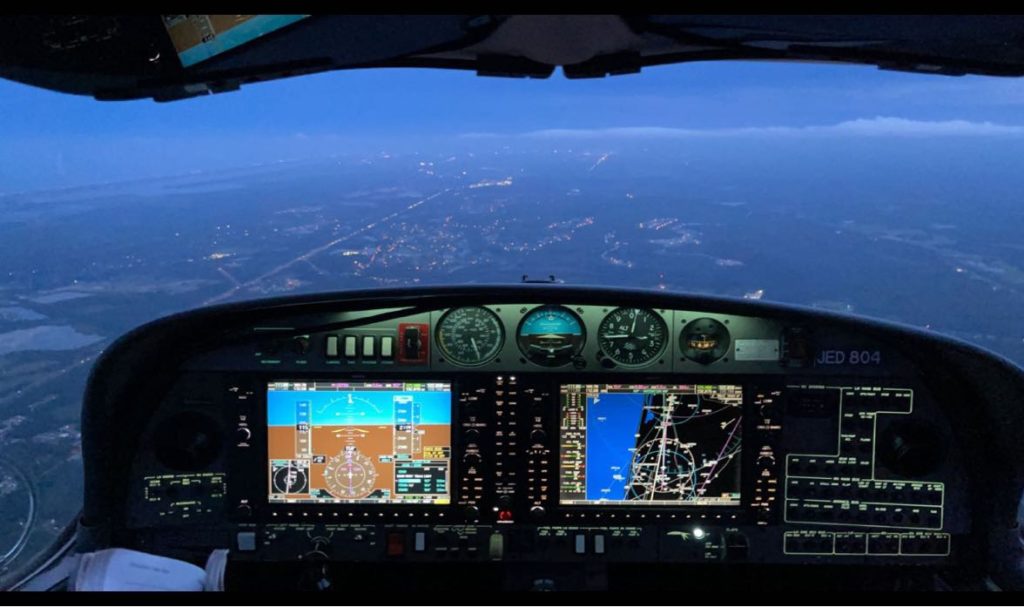
Instrument flying has come a long way from the days of steam gauges and dog-eared paper charts. Today, glass flight decks give you full-color synthetic vision, moving maps, real-time traffic and weather overlays—and GPS approaches have opened up thousands of runways that used to be off-limits in low weather.
But here’s the truth: technology is only as good as the pilot using it. The core of instrument flying hasn’t changed—scan, interpret, control. Whether you’re behind a six-pack panel or the newest glass suite, those skills are what keep you safe when the screens go dark.
Pro Tip: If possible, start on steam gauges to cement your scan and raw-data skills, then transition to a glass flight deck to build modern IFR workflows and automation management. Learning steam gauges first is like learning to drive a stick shift before an automatic transmission.
Weather: Your New Frenemy
Once you earn your instrument rating, weather stops being an automatic “no-go” and becomes a strategic decision. You’ll start reading METARs, TAFs, and prog charts with the intensity of a meteorologist—learning to distinguish between weather that you can manage and weather that demands you to stay on the ground.
You’ll still avoid the big threats—icing, embedded thunderstorms, severe turbulence—but that stubborn layer of stratus or patchy fog that used to cancel your trips? Now it’s just part of the plan.
Pro Tip: The goal isn’t to beat the weather—it’s to understand it well enough to know when to work with it and when to walk away.
Real-World Applications & Safety
An instrument rating turns flying from a weather-dependent hobby into dependable transportation. Business trips become more predictable, family trips are no longer hostage to the forecast, and cross-country adventures are planned with confidence—not nervously refreshing the METAR hoping the ceiling holds.
You’ll open up routes and destinations that were impossible as a VFR-only pilot—and you’ll do it safely. Especially in weather related situations. Why? Because instrument training builds precision flying habits, strong weather judgment, and sound decision-making under pressure.
The structured mindset you develop—checklist discipline, procedure adherence, and methodical thinking—carries over to every flight you’ll ever make, no matter the weather.
Making the Investment
What You Invest
- Time – consistent lessons, not bursts.
- Money – aircraft, instructor, study resources—budget for more than the FAA minimums.
- Focus – weekly prep and review.
What You Get Back
- Utility – trips you once canceled are now flights.
- Skill – sharper procedures, judgment, and discipline—even on VFR days.
- Confidence – you operate in the system with a plan, not with fingers crossed the forecast holds.
Pro Tip: Use structured study to save money and reduce relearning in the flight deck. MzeroA’s Instrument Pilot Course keeps you progressing every session.
The Proficiency Challenge
An instrument rating isn’t a “get it and forget it” certificate. IFR skills fade quickly—much faster than VFR —and the FAA’s currency rules reflect that. To stay sharp, you’ll need to fly regular approaches, holds, and intercepts, either in real IMC or under the hood with a safety pilot.
Many pilots find that staying current is even harder than earning the rating. The skills are perishable, and rusty instrument flying can be dangerous. The key is consistency: small, frequent practice sessions keep your scan smooth and your decision-making sharp.
Build a Simple Currency Plan:
- Set a cadence – aim for short, frequent refreshers (sim or hood) and log 6-HIT on a rolling basis: 6 approaches, a hold, and intercept/track work.
- Rotate scenarios – mix in unfamiliar airports, different approach types (ILS, LPV, LOC, VOR, LNAV), and a planned missed with a hold.
- Update on schedule – keep databases and charts current on each cycle and review critical NOTAMs that affect your procedures.
- Debrief with data – use track logs/notes to capture areas that need improvements.
Even if you’re already rated, MzeroA’s Instrument Pilot Course is a top review tool and perfect prep for your IPC
The Bottom Line
The instrument rating is challenging, demanding, and absolutely worth it. It’s the difference between flying when the weather cooperates and flying with a plan when it doesn’t. You’ll sharpen your procedures, make better decisions, and turn your airplane into true transportation.
Yes, there’s work involved—new habits, new checklists, new ways of thinking—but the payoff is huge. When you break out at minimums on a stabilized approach or complete a cross-country you would’ve scrubbed as a VFR-only pilot, you’ll understand why so many pilots call the instrument rating their most valuable upgrade.
Ready to Get Started?
Try MzeroA free for two weeks and begin your Instrument Pilot Online Ground School today—one clear lesson at a time.