
If you’ve spent any time looking for pilot books, you already know there’s no shortage of aviation training books. The hard part isn’t access. It’s deciding which ones are worth your time.
Between FAA handbooks, test prep, reference manuals, and “must-read” recommendations, it’s easy to start gathering resources faster than you can realistically use them.
This guide focuses on the aviation training books that serve a clear purpose at each stage of training, with FAA resources as the backbone so you can spend more time learning and less time chasing resources that don’t move you forward.
The FAA Books Every Pilot Should Know
No matter which certificate you’re working on, FAA publications are the common thread through all flight training. They’re not optional references, and they’re not just “test material.” They’re the baseline the FAA expects pilots to understand and they’re the resources examiners assume you’ve spent time with.
These books will follow you through every stage of training:
- Pilot’s Handbook of Aeronautical Knowledge (PHAK)
This is where the fundamentals live. Aerodynamics, weather theory, aircraft systems, and regulations all start here. It’s not a quick read, but it’s one you’ll come back to repeatedly—long after your first checkride. - Airplane Flying Handbook
Think of this as the practical counterpart to the PHAK. It explains how knowledge shows up in the airplane, from basic maneuvers to more advanced operations. - Aviation Weather Handbook
A more modern take on weather that connects theory to real-world decision-making. This is especially useful once forecasts start influencing go/no-go calls instead of just test answers. - Risk Management Handbook
Often overlooked, but increasingly important. This book reflects how the FAA expects pilots to think about risk, not just follow procedures. - FAR/AIM
Not meant to be read cover to cover. What matters is knowing how to navigate it and where to find answers when questions come up. - Airman Certification Standards (ACS)
This is the roadmap. Every knowledge test question, oral exam topic, and checkride task traces back to the ACS. - POH / AFM (Aircraft-Specific)
This is the book examiners expect you to know for your airplane.
These are the core references pilots keep coming back to throughout training, no matter which certificate you’re working on. They’re worth knowing well.
Private Pilot Books: Building the Foundation
Private pilot training is where everything starts. It’s easy to feel overwhelmed without some structure.
At this stage, aviation training books should help you understand how flying works—not just what to memorize for the written test. That foundation carries forward into instrument, commercial, and beyond.
FAA Private Pilot Handbooks and ACS
- Pilot’s Handbook of Aeronautical Knowledge (PHAK)
This is where the fundamentals live. Aerodynamics, weather, aircraft systems, and regulations all start here. It’s not something you read once and move on from—you’ll reference it throughout your training. - Airplane Flying Handbook
This book connects ground knowledge to what happens in the airplane. Maneuvers, procedures, and technique all start to make more sense once this becomes familiar. - FAR/AIM + Private Pilot ACS
The ACS defines what you’re expected to know and demonstrate. The FAR/AIM tells you where the rules come from. Learning how these two work together early pays off later. - Aircraft POH / AFM
This is the one book that’s specific to your airplane. Examiners expect you to know it—not in general terms, but in detail.
MzeroA Companion Books
- Private Pilot Blueprint
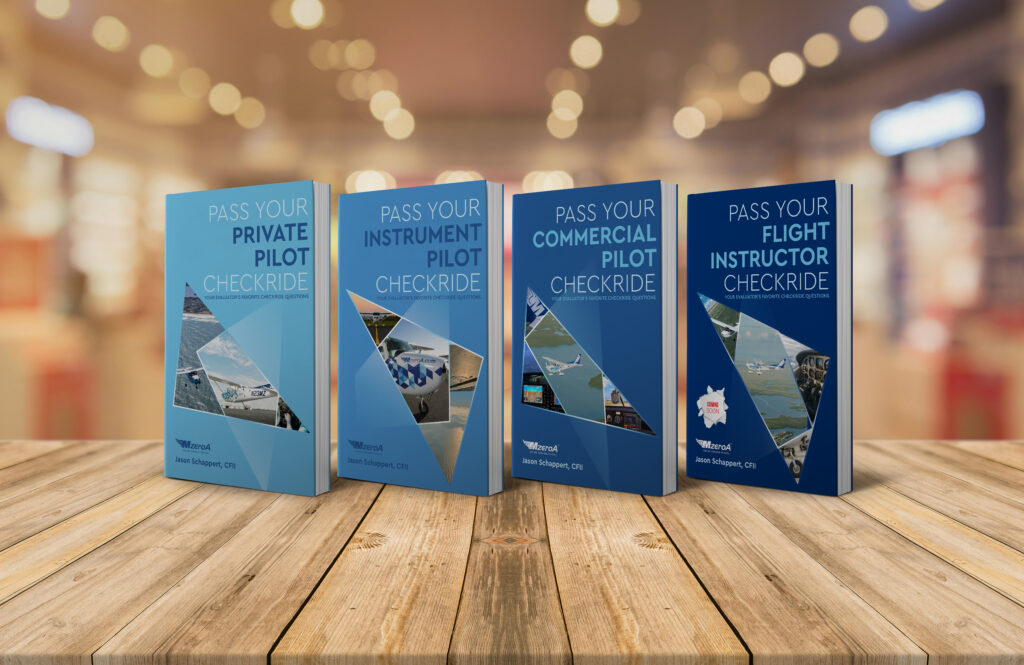
Built to orient new pilots at the very beginning. This book helps you understand the training process before you’re buried in details, acronyms, and checklists. - Pass Your Private Checkride
Built around the ACS and real checkride expectations, this book helps students understand how examiners think, what they listen for, and how to clearly explain knowledge during the oral exam.
When used intentionally, these resources build understanding that carries from the study desk to the flight deck and into the checkride. MzeroA Online Ground School offers a full collection of Pass Your Checkride Book Series.
Instrument Pilot: The Resources That Help IFR Make Sense
Instrument training is where individual procedures start to connect into a system.
Flying IFR isn’t about running checklists or following steps in isolation. It’s about understanding how weather, airspace, clearances, and procedures work together as a system. When the system clicks, workload becomes manageable. When it doesn’t, pilots tend to fall behind quickly.
At this stage, aviation training books should help you connect the dots, not just pass the written.
FAA Handbooks and ACS for Instrument Training
- Instrument Flying Handbook
This is the FAA’s primary reference for instrument flying fundamentals, from scan and attitude instrument flying to holding and approaches. - Instrument Procedures Handbook
Where procedures live. Departures, arrivals, approaches, and how the IFR system actually operates day to day. - Aviation Weather Handbook
At the instrument level, weather becomes operational. This book helps connect forecasts and products to real go/no-go decisions. - Risk Management Handbook
As IFR complexity and workload builds, decision-making matters earlier. This resource helps frame those choices ahead of time. - FAR/AIM + Instrument ACS
These define what you’re expected to know, explain, and demonstrate—on the written, the checkride, and in the airplane.
MzeroA Companion Book
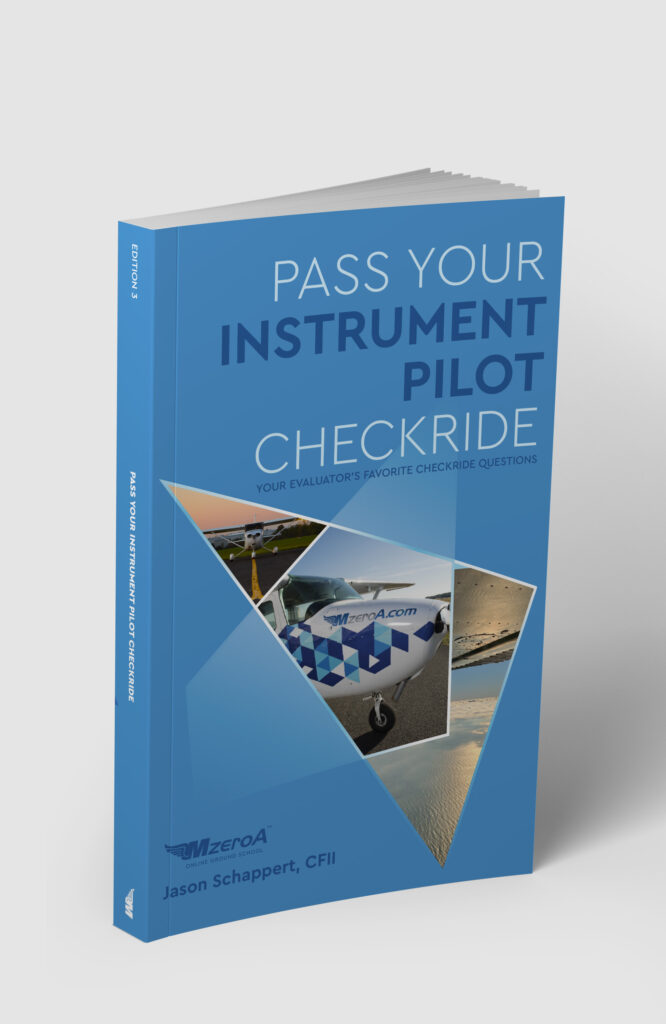
Pass Your Instrument Checkride: Focuses on the IFR checkride, helping pilots connect procedures, regulations, and scenarios into clear, examiner-ready explanations.
The value of these books is learning how IFR planning, procedures, and decisions connect—especially when the workload increases.
Commercial Pilot: References That Raise the Standard
Training for a Commercial Pilot License (CPL) isn’t about relearning the fundamentals. It’s about holding yourself to a higher standard.
By this stage, most of the knowledge is familiar. The difference is how precisely you apply it, how consistently you perform, and how clearly you can explain your decisions. Aviation training books at the commercial level should help tighten margins, not introduce entirely new concepts.
FAA Handbooks and ACS for Commercial Pilots
- Pilot’s Handbook of Aeronautical Knowledge
Still relevant, but now used for depth. Expect to explain concepts more clearly and at a higher level than before. - Airplane Flying Handbook
This becomes a standard reference for maneuver technique, tolerances, and consistency. - Risk Management Handbook
Decision-making carries more weight at the commercial level. This book supports the FAA’s expectations around professionalism and judgment. - FAR/AIM + Commercial ACS
At this stage, examiners expect you to know not just what’s required, but where it comes from and how it applies operationally.
MzeroA Companion Book
- Pass Your Commercial Checkride
Designed to prepare pilots for the higher standards and deeper questioning of the commercial pilot checkride.
Rather than adding more material, these resources help commercial students sharpen what they already know—bringing clarity, consistency, and confidence to both the flight deck and the checkride.
Flight Instructor: Books That Teach You How to Teach
Flight instructor training isn’t about learning more aviation. It’s about learning how to teach what you already know.
The shift is subtle but significant. You’re no longer studying just to answer questions correctly. You’re learning how to explain concepts clearly, spot gaps in understanding, and adjust on the fly when a student doesn’t quite get it the first time.
Instructing requires maintaining a broad, working knowledge—not just deep expertise in one area.
CFI: Mastery of the Foundations
A CFI is expected to be fluent in Private and Commercial material—because that’s what you’ll be teaching day to day.
That means revisiting:
- Private Pilot ACS
- Commercial ACS
- PHAK and Airplane Flying Handbook (this time from a teaching perspective)
- FAR/AIM with emphasis on instructional privileges and limitations
At this stage, aviation training books become teaching tools, not just references.
FAA CFI ACS and Handbook
- Flight Instructor ACS
- Aviation Instructor’s Handbook
This book shapes how the FAA expects instructors to think about learning, evaluation, and student progress. It’s foundational for every CFI applicant.
CFII: Instrument References Instructors Must Know
A CFII builds on the CFI foundation—but with a broader knowledge requirement.
In addition to Private and Commercial, CFIIs must be fully fluent in:
- Instrument ACS
- Instrument Flying Handbook
- Instrument Procedures Handbook
The expectation isn’t just that you can fly IFR—it’s that you can explain how the system works and teach students to manage workload effectively and safely.
At the instructor level, aviation training books shift from “what do I know?” to “how do I teach this clearly?” That distinction defines effective instructors.
Aviation Training Books That Go Beyond Training and Checkrides
Some aviation books aren’t tied to a specific certificate or test—and that’s exactly why they matter.
These are the books pilots return to after the checkride pressure is gone. They don’t exist to help you pass anything. They exist to help you think better, manage risk more honestly, and understand flying at a deeper level.
- Stick and Rudder
First published decades ago and still unmatched. This book explains how airplanes fly in a way that makes sense. If coordination, control feel, or basic aerodynamics ever felt fuzzy, this book has a way of making it click—regardless of experience level. - The Killing Zone
A sobering look at accident trends, particularly during the 50–350 hour window. It focuses less on “pilot error” and more on decision-making, complacency, and risk accumulation—topics every pilot should be honest about.
These books won’t replace FAA handbooks or structured training. What they do is add perspective—helping pilots connect technical knowledge to real-world consequences.
They remind you that good piloting isn’t just about knowing the right answer. It’s about recognizing risk early and making decisions that keep you out of trouble.
Quality Over Quantity
Aviation training books are tools. Powerful ones—but only when they’re used with intention.
The mistake most students make isn’t choosing the “wrong” book. It’s trying to use every book at once, or using the right book at the wrong stage. FAA handbooks provide the standard. Checkride prep helps focus your study. Broader aviation books shape judgment and perspective. Each has a role.
The most effective approach in 2026 is selective, structured, and realistic. Know which references support the certificate you’re working on. Revisit the ones that matter most. And don’t be afraid to return to the fundamentals as your understanding deepens.
Pairing FAA resources with structured learning—like the published books and ground training from MzeroA Online Ground School—helps turn information into understanding. Not by replacing the FAA material, but by organizing it in a way that makes sense for real training and real flying.
You don’t need every aviation book ever published. You need the right ones, used the right way.
Don’t Miss the Private Pilot Blueprint
Just getting started your flight training journey or haven’t taken the leap just yet? Don’t miss The Private Pilot Blueprint – your definitive roadmap to saving both time and money on your private pilot certificate. This essential guide is packed with tips, strategies, and step-by-step advice to help you. Because…a good pilot is always learning!