
Controlled airspace (Classes A–E) puts ATC in the loop; pilots may need a clearance, two-way radio communication, or both before entering. Class G, the only uncontrolled airspace in the U.S. system, operates without ATC authority; see-and-avoid and self-separation are entirely the pilot’s responsibility. That divide shapes every rule covered in this guide.
Overview of FAA Airspace Classifications
The Federal Aviation Administration (FAA) organizes U.S. skies into different airspace classes to maintain safety, manage air traffic, and protect public interest. Each classification has specific altitude ranges, entry requirements, and Air Traffic Control (ATC) rules. Understanding these differences is essential for any pilot, whether flying under Instrument Flight Rules (IFR) or Visual Flight Rules (VFR). You’ll also need to know VFR weather minimums, required equipment (i.e. ADS-B/Mode C), and speed limits by class.
Key Takeaways
- In controlled airspace, ATC provides services such as traffic separation. In uncontrolled airspace, pilots are responsible for maintaining separation from other aircraft and operating without active ATC control.
- Class A begins at 18,000 feet MSL. All operations must be conducted under IFR.
- Class B, C, and D airspace each require two-way radio communication before entry; Class B also requires an explicit clearance.
- When a part-time Class D tower closes, the airspace reverts to surface Class E or Class G, depending on whether weather reporting is available.
- VFR weather minimums vary by airspace class and altitude. Class G has the most lenient daytime minimums (1 SM visibility, clear of clouds below 1,200 feet AGL) but they tighten significantly at night.
- Special use airspace (including Restricted Areas, MOAs, and TFRs) overlays the standard class structure and requires a NOTAM check before every flight.
- Drone pilots need LAANC authorization to fly in controlled airspace; Class G below 400 feet AGL requires no prior authorization but Part 107 rules still apply.
| Class | Altitude | Controlled? | Entry Requirement | Equipment | VFR Speed |
| A | 18,000′ MSL – FL600 | Yes (IFR only) | IFR clearance | Mode C + ADS-B Out | Mach 1 |
| B | Surface – ~10,000′ MSL | Yes | explicit “Cleared into the Class Bravo airspace” ATC clearance | Mode C inside the Mode C Veil + ADS-B OUT + Two-Way Radio | Inside Class B, below 10,000′ MSL: 250 KIAS Inside Class B, above 10,000′ MSL: Mach 1 Beneath Class B or in VFR corridor through Class B: 200 KIAS |
| C | Surface – 4,000′ AGL | Yes | Two-way comms + call sign acknowledged: this is established the moment ATC responds to your call using your exact aircraft call sign (e.g., “Blue Phoenix 290, standby”) | Two-way radio, Mode C transponder, ADS-B Out | For class Charlie and Delta, the speed limit is 200 knots at or below 2,500 feet and within 4 nautical miles of the primary Class C or Class D airport. |
| D | Surface – 2,500′ AGL | Yes | Two-way radio (hear callsign) | Two-way radio for class Delta | For class Charlie and Delta, the speed limit is 200 knots at or below 2,500 feet and within 4 nautical miles of the primary Class C or Class D airport. |
| E | Echo starts at the surface, 700ft AGL, 1200ft AGL, or 14,500ft MSL | Yes | None for VFR | ADS-B + Mode C above 10,000ft MSL | 250 KIAS below 10,000′ MSL |
| G | Surface – base of Class E | No | None | Above 10,000 feet MSL: Mode C transponder and ADS-B Out. Inside a Mode C Veil: Mode C | 250 KIAS below 10,000′ MSL |
Class A, B,C, D, and E Airspace Explained
Class A Airspace
- Altitude: 18,000’ MSL up to and including FL600.
- Operations: IFR only
- Requirements: Continuous two-way communication with ATC; Mode C transponder, and ADS-B Out required.
Class B Airspace
- Shape: “upside down wedding cake” around the busiest airports, surface to typically 10,000’ MSL.
- Entry: ATC clearance required before entry.
- Weather Minimum: 3 statute miles visibility, clear of clouds.
- Equipment: Mode C transponder and ADS-B Out required inside the Class B and within the 30-nautical mile “Mode C veil” (common trap for pilots).
- Speed Limits: Less than or equal to 250 KIAS below 10,000’ MS; less than or equal to 200 KIAS within 4-nautical miles of the airport at/under 2,500’ AGL, as well as in VFR corridors/underlying shelves.
- Pilot Certification: Student pilots require a logbook endorsement to operate in Class B; sport pilots are not permitted.
Class C Airspace
- Shape: Surface to 4,000’ AGL with a 5-nautical mile inner core radius. The outer shelf is 1,200’ to 4,000’ AGL within a 10-nautical mile radius.
- Outer Area: ATC provides radar services within a 20-nautical mile radius.
- Entry: Must establish two-way radio communications, you must hear your callsign from ATC before entering.
- Equipment: Two way radios, ADS-B out and Mode C
Class D Airspace
- Altitude: Surface to 2,500ft AGL with a 4-nautical-mile (NM) radius
- Airports: Surrounds smaller towered airports.
- Entry: Must establish and maintain two-way communication with the tower (hearing your callsign).
- Notes: Reverts to Class E or G when the tower is closed (check Chart Supplement or NOTAMs).
- Equipment: Two-way radios
- Speed Limits: Less than or equal to 200 knots at or below 2,500 feet AGL (Above Ground Level) and within 4 nautical miles of the primary airport in that Class D airspace.
- Part-Time Towers: Not all Class D towers operate 24/7; when closed, the airspace reverts to Class E (if weather/comm requirements are met) or Class G (if not).
- Identifying Part-Time Status: Marked with an asterisk (*) on sectional charts, with exact operating hours listed in the Chart Supplement (formerly the A/FD).
- Pre-Flight Check: Always verify tower hours before flying into an unfamiliar Class D airport, especially for early morning or evening arrivals.
Class E Airspace:
- Definition: Controlled airspace not classified as A-D.
- Floors: Can begin at the surface, 700’ AGL, 1,200’ AG, or 14,500’ MSL. Extends up to but not including 18,000’ MSL, and resumes at/above FL600.
- Operations: IFR clearance required; VFR has no radio requirement.
- Equipment: At or above 10,000 feet MSL: ADS-B Out and a Mode C transponder.
- Watch the floor of Class E carefully, if it starts at the surface or 700’ AGL, there’s less Class G below.
- For a full breakdown of Class E floors, surface areas, and how to read vignettes on a sectional chart, see our Class E Airspace Explained guide.
Controlled vs Uncontrolled Airspace
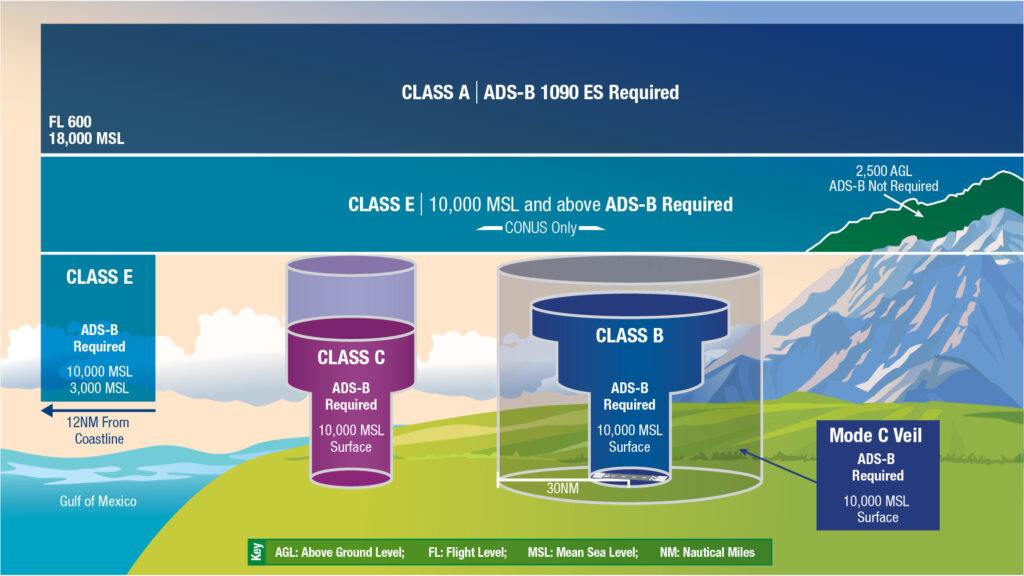
Controlled airspace includes Class A through E, where ATC provides varying levels of traffic management and separation. In Class B, C, and D airspace, VFR pilots must obtain and maintain the required communication or clearance and then comply with all ATC instructions. In Class E, VFR pilots are not required to talk to ATC, but if communication is established, they must follow any instructions given.
Uncontrolled airspace, Class G, has no ATC services. Pilots are fully responsible for navigation, collision avoidance, and self-announcing when appropriate on Common Traffic Advisory Frequency (CTAF).
- VFR Weather Minimum in Class G (example): Below 1,200’ AGL during the day = 1 statue mile visibility and clear of clouds.
VFR Weather Minimums by Airspace Class
VFR weather minimums define the lowest acceptable visibility and cloud clearance for flight under visual flight rules. The FAA sets these requirements by airspace class, and in some cases, by altitude and time of day. They appear on the FAA written exam and are tested on the checkride, so every student pilot needs to know them cold. The full regulatory source is 14 CFR 91.155.
Class A – No VFR operations permitted. All flight in Class A must be conducted under IFR.
Class B – 3 statute miles visibility. Clear of clouds. The logic here is simple — Class B surrounds the busiest airports in the country, and ATC is providing separation, so cloud clearance is less critical than in less controlled environments.
Class C and D – 3 statute miles visibility. 500 feet below, 1,000 feet above, 2,000 feet horizontal from clouds.
Class E – When at or above 10,000 feet MSL: 5 statute miles visibility; 1,000 feet below, 1,000 feet above, 1 statute mile horizontal from clouds.
Below 10,000 feet MSL: 3 statute miles visibility; 500 feet below, 1,000 feet above, 2,000 feet horizontal from clouds.
Class G – the most detail required
Class G has the most nuanced minimums because it varies by altitude and time of day.
Day, below 1,200 feet AGL: 1 statute mile visibility. Clear of clouds. This is the most permissive standard in the entire airspace system.
Night, below 1,200 feet AGL: 3 statute miles visibility. 500 feet below, 1,000 feet above, 2,000 feet horizontal from clouds. Night operations introduce meaningful cloud clearance requirements even at low altitude.
Day or night, above 1,200 feet AGL and below 10,000 feet MSL: 1 statute mile visibility during the day; 3 statute miles at night. Cloud clearance is 500 feet below, 1,000 feet above, 2,000 feet horizontal.
Day or night, at or above 10,000 feet MSL: 5 statute miles visibility. 1,000 feet below, 1,000 feet above, 1 statute mile horizontal from clouds — same as Class E at those altitudes.
These minimums are a consistent topic on the FAA Private Pilot written exam. If you want a deeper look at how to read airspace on a sectional chart, see our VFR sectional chart guide and Class E Explained posts for context on where these rules apply on the ground.
Airspace Rules for Drone Pilots (UAS)
Drone pilots operating under Part 107 follow the same controlled/uncontrolled airspace structure as manned aircraft, with a few key differences in how authorization works.
Controlled Airspace – Flying a drone in Class B, C, D, or surface Class E requires FAA authorization before the flight. Most operators get this through LAANC (the Low Altitude Authorization and Notification Capability) which provides near-instant authorization through apps like AirMap or Aloft. Authorization is site-specific and altitude-specific; it is not a blanket clearance for an entire airspace class.
Uncontrolled Airspace – Class G airspace below 400 feet AGL requires no prior authorization. Standard Part 107 rules still apply: drone must remain within visual line of sight, below 400 feet AGL, and clear of people and structures unless waivered.
For a complete breakdown of how to plan and execute drone flights in both environments, see How to Fly in Controlled and Uncontrolled Airspace.
Special Use Airspace
Standard airspace classes (A through G) describe who controls the airspace and what communication is required. Special use airspace (SUA) is a separate overlay that restricts or warns pilots about specific activities happening within defined boundaries. It exists independently of the class structure, and it requires its own preflight check.
Restricted Areas – Restricted areas contain hazardous activities (weapons testing, artillery, aerial gunnery) that are dangerous to nonparticipating aircraft. Civilian flight through a restricted area is not automatically prohibited, but it requires permission from the controlling agency when the area is active. When inactive, it may be available for transit. Always check NOTAMs and contact the controlling agency if you are unsure of status. Restricted areas are depicted on sectional charts with an “R” designation.
Military Operations Areas (MOAs) – MOAs are established to separate military training activity (aerobatics, high-speed maneuvering, formation flying) from IFR traffic. VFR pilots are not prohibited from transiting an active MOA, but the FAA strongly advises against it. If you must go through, contact the controlling agency and be prepared to maneuver on short notice. Check MOA status at notams.faa.gov or through your EFB before departure.
Prohibited Areas – Prohibited areas are exactly what the name implies: no civilian flight, no exceptions, no permission to request. These protect national security or critical infrastructure. The White House, Camp David, and certain nuclear facilities fall under prohibited area designations. They are marked with a “P” on sectional charts.
Warning Areas – Warning areas extend from 3 nautical miles offshore over international waters and may contain the same hazardous military activities as restricted areas. Because they are over international water, the FAA cannot legally prohibit civilian flight, but the warning is real. Check NOTAMs before transiting.
Temporary Flight Restrictions (TFRs) – TFRs are issued on short notice and can pop up anywhere in the NAS, for presidential movement, airshows, sporting events, disaster response, or VIP security. They are time-limited but strictly enforced. TFR violations have resulted in certificate actions and intercepts. Check notams.faa.gov or your EFB as close to departure as possible. A TFR issued after your initial preflight can catch pilots who do not check again before engine start.
Why FAA Airspace Classification Matters
Navigating airspace correctly prevents violations, improves safety, and builds pilot confidence. Whether operating in dense Class B airspace or rural Class G, knowing entry requirements, altitude limits, and communication protocols is a critical skill.
Take Your Airspace Knowledge to New Heights with MzeroA Online Ground School
Knowing the difference between Class B and Class C is one thing. Applying it under pressure on your written exam (and on a checkride) is another. MzeroA’s Online Ground School walks you through every airspace class, VFR weather minimum, and equipment rule with the same clarity you found in this guide. Students who train with MzeroA score an average of 6 points above the national average on their FAA written exams. Start your 2-week free trial at mzeroa.com/trial, with no credit card required.